Secretive inhabitants of the Andes. Photographic guide to the diversity of birds found in the Polylepis forests of Ecuador
DOI:
https://doi.org/10.54753/blc.v16i1.2634Keywords:
Polylepis, High Andean biodiversity, Avifauna, Habitat fragmentation, ConservationAbstract
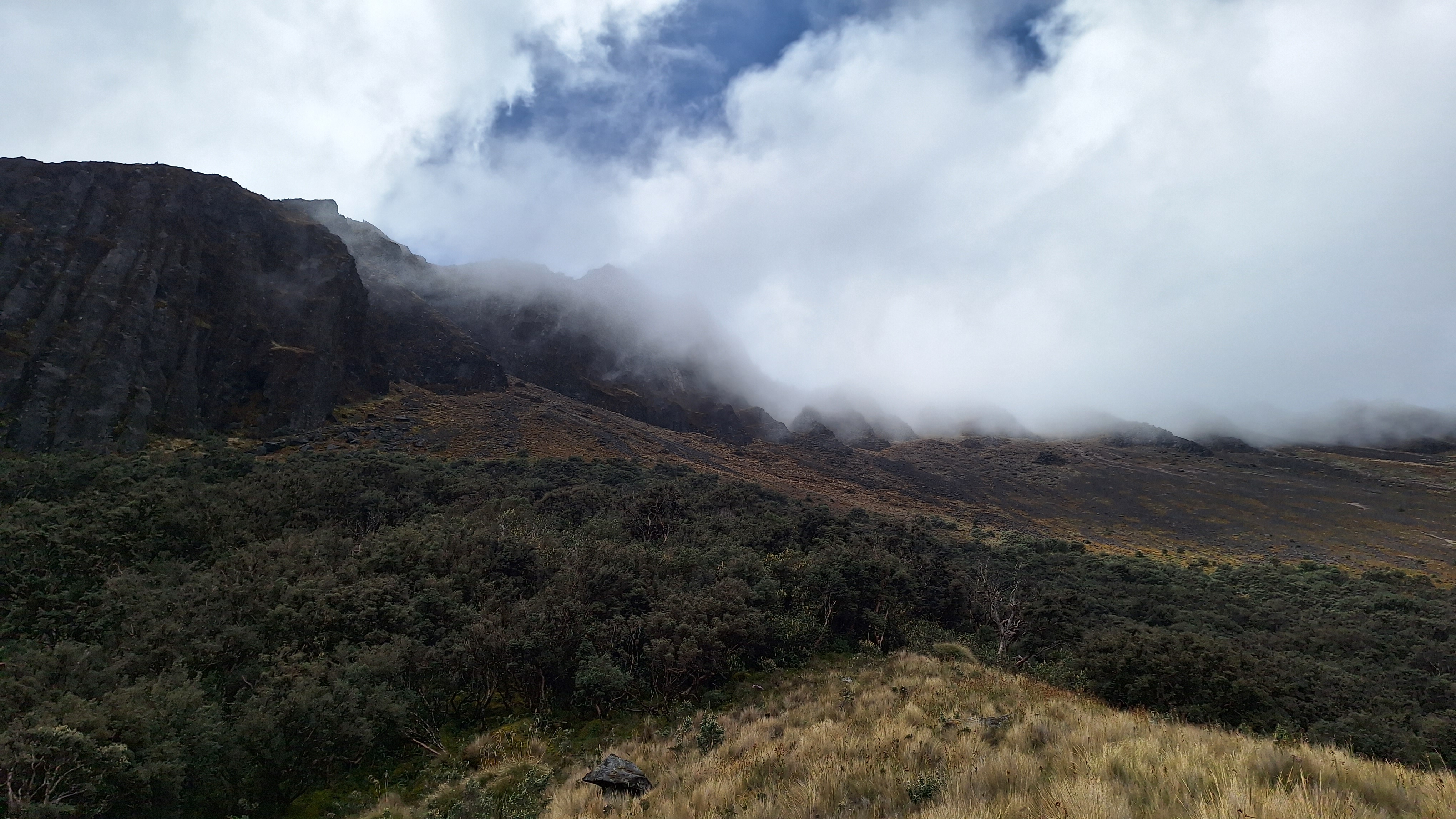
The high Andean Polylepis forests are unique ecosystems characterized by high biodiversity and strong species specialization. In Ecuador, these forests are highly fragmented and have lost more than 90% of their original coverage due to deforestation, grazing, agricultural expansion, and resource extraction. Climate change increases their vulnerability by forcing their altitudinal displacement to more restricted areas, affecting numerous species dependent on these habitats.In this study, three locations with native Polylepis forests in the northern and central Andes of Ecuador were evaluated. Bird sampling was carried out using count points between July and December 2023. Forty-nine species belonging to 18 families were recorded, with the most diverse being Thraupidae, Trochilidae, and Tyrannidae. Two species are nationally threatened: Chalcostigma stanleyi (Vulnerable) and Conirostrum binghami (Endangered). In addition, the known altitudinal range of Phyllomyias uropygialis was expanded.The results highlight the importance of conserving and restoring the remaining Polylepis forests, whose integrity is essential for maintaining high Andean biodiversity, promoting ecological connectivity, and mitigating the effects of climate change.References
Astudillo, P. X., Grass, I., Siddons, D. C., Schabo, D. G., & Farwig, N. (2020). Centrality in Species-Habitat Networks Reveals the Importance of Habitat Quality for High-Andean Birds in Polylepis Woodlands. Https://Doi.Org/10.13157/Arla.67.2.2020.Ra5, 67(2), 307–324. https://doi.org/10.13157/ARLA.67.2.2020.RA5 DOI: https://doi.org/10.13157/arla.67.2.2020.ra5
Fjeldsa, J. (1993). The avifauna of the Polylepis woodlands of the Andean highlands: the efficiency of basing conservation priorities on patterns of endemism. Bird Conservation International, 3–37. https://doi.org/10.1017/S0959270900000770 DOI: https://doi.org/10.1017/S0959270900000770
Fjeldsà, J. (2002). Polylepis Forests-Vestiges of a vanishing ecosystem in the Andes. Society for Tropical Ecology, 111–123. https://www.soctropecol.eu/publications/pdf/8-2/Fjeldsa_J_2002_Ecotropica8_111-123.pdf
Freile, J., Santander G., T., Jiménez-Uzcátegui, G., Carrasco, L., Diego Cisneros-Heredia, Guevara, E., A., S.-N., & Tinoco, B. A. (2019). Lista Roja de las Aves del Ecuador. Ministerio del Ambiente, Aves y Conservación, Comité Ecuatoriano de Registros Ornitológicos, Fundación Charles Darwin, Universidad del Azuay, Red Aves Ecuador & Universidad San Francisco de Quito.
Freile, J., & Restall, R. (2018). Birds of Ecuador. UK: Helm Field Guides.
Gómez, I., Calbimonte, R., Domic, A., Palabral, A., Hurtado, R., & Liberman, M. (2019). Ensambles de Aves de los Bosques Endémicos de Polylepis pacensis en Bolivia. Ornitología Neotropical, 30, 27–31. https://scispace.com/pdf/ensambles-de-aves-de-los-bosques-endemicos-de-polylepis-52ihryvurt.pdf DOI: https://doi.org/10.58843/ornneo.v30i0.333
Ministerio del Ambiente del Ecuador. (2013). Sistema de Clasificación de Ecosistemas del Ecuador Continental. Subsecretaría de Patrimonio Natural.
Moore, J., Krabbe, N., & Jahn, O. (2013). Bird sounds of Ecuador, a comprehensive collection. In CA, USA: John V Moore Nature Recordings.
Purcell, J., & Brelsford, A. (2004). Reassessing the Causes of Decline of Polylepis, a Tropical Subalpine Forest. ECOTROPICA, 10, 155–158. https://purcelllab.ucr.edu/pdfs/Purcell,Brelsford%202004.pdf
Remsen, J. V, J. I. Areta, E. Bonaccorso, S. Claramunt, G. Del-Rio, A. Jaramillo, D. F. Lane, M. B. Robbins, F. G. Stiles, & K. J. Zimmer. (2024). A classification of the bird species of South America. Museum of Natural Science. Version (17/06/2024). Louisiana State University. https://www.museum.lsu.edu/~Remsen/SACCBaseline.htm
Tinoco, B. A., Astudillo, P. X., Latta, S. C., Strubbe, D., & Graham, C. H. (2013). Influence of Patch Factors and Connectivity on the Avifauna of Fragmented Polylepis Forest in the Ecuadorian Andes. Biotropica, 45(5), 602–611. https://doi.org/10.1111/BTP.12047 DOI: https://doi.org/10.1111/btp.12047
Published
How to Cite
Issue
Section
License
Copyright (c) 2025 Mayra Caiza

This work is licensed under a Creative Commons Attribution-NonCommercial-ShareAlike 4.0 International License.
This work is published under the Creative Commons Attribution-NonCommercial-ShareAlike 4.0 International (CC BY-NC-SA 4.0) license. This means that users may copy, distribute, and adapt the content, provided that proper credit is given to the authors and the journal. Commercial use of the material is not permitted. Additionally, any derivative work must be distributed under the same license. This license ensures open access to knowledge, promoting the dissemination and reuse of published works for non-commercial purposes, respecting authorship, and ensuring the free circulation of content under fair terms.