Valuation and marketing of non-timber forest products in Cofán Bermejo
DOI:
https://doi.org/10.54753/blc.v16i1.2510Keywords:
sustainable management, Market prices, Ecuadorian Amazon, use value, local bioeconomyAbstract
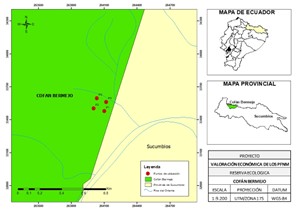
Non-timber forest products (NTFPs) are essential to the livelihoods of rural Amazonian communities and to conserving their ecosystems. This study assessed the population structure, abundance, uses, and market prices of NTFPs in the Cofán Bermejo Ecological Reserve (RECB) to inform commercial reforestation strategies. The methodology involved a floristic inventory within a 100 × 100 m plot, recording all tree individuals with a diameter at breast height (DBH) ≥ 10 cm. In addition, surveys were conducted across three markets in Lago Agrio to document uses, parts harvested, and sale prices; economic valuation was performed using the market price method. A total of 270 individuals were recorded, dominated by smaller diameter classes, indicating a young population structure with high regeneration potential. The most abundant species were Iriartea deltoidea Ruiz & Pav. (20.37%) and Otoba parvifolia (Markgr.) A.H. Gentry (15.56%). Twenty species were identified with predominantly edible (39.3%), medicinal (21.5%), and artisanal (19.1%) uses. The family Arecaceae stood out for its multiple uses, while several other species were valued for their dual food and medicinal functions, essential for local livelihoods and health. Overall, NTFPs in the RECB exhibit high diversity and socioeconomic value, and their population structure supports the implementation of sustainable management and conservation strategies to strengthen the local bioeconomy.References
Aguirre, Z., & Aguirre, L. (2021). Estado actual e importancia de los productos forestales no maderables. Bosques Latitud Cero, 11(1), 71–82. https://revistas.unl.edu.ec/index.php/bosques/article/view/925
Aguirre, Z., Rivera, M., & Granda, V. (2019). Productos forestales no maderables de los bosques secos de Zapotillo, Loja, Ecuador. Arnaldoa, 26(2), 575–594. https://doi.org/10.22497/arnaldoa.262.26204
Baltazar, O. (2011). Estudio etnobotánico y de mercado de productos forestales no maderables extraídos del bosque y áreas afines en la ciudad de Pucallpa-Perú [Tesis de pregrado, Universidad Nacional de Ucayali]. https://repositorio.utn.edu.ec/handle/123456789/119
Beltrán-Rodríguez, L., Ortiz-Sánchez, A., Mariano, N. A., Maldonado-Almanza, B., & Reyes-García, V. (2014). Factors affecting ethnobotanical knowledge in a mestizo community of the Sierra de Huautla Biosphere Reserve, Mexico. Journal of Ethnobiology and Ethnomedicine, 10(14), 1–19. https://doi.org/10.1186/1746-4269-10-14
González, A., & Sans, C. (2007). Productos forestales no madereros del bosque: Un significativo aporte económico a la empresa forestal. Ciencia e Investigación Forestal, 13(1), 187–202. https://doi.org/10.52904/0718-4646.2007.277
Guala, P., Monar, R., & Mestanza-Ramón, C. (2022). Diversidad alfa de pteridofitas en el bosque siempre verde de tierra bajas de la Reserva Ecológica Cofán Bermejo, Sucumbíos – Ecuador. Green World Journal, 05(01), 1–17. https://doi.org/10.53313/gwj51014
Guamán-Songor, J., Peña-Tamayo, J., Jaramillo-Díaz, N., & Granda Pardo, J. (2021). Productos forestales no maderables de origen vegetal en cinco comunidades rurales del cantón Palanda, provincia de Zamora Chinchipe, Ecuador. Bosques Latitud Cero, 11(1), 43–56. https://revistas.unl.edu.ec/index.php/bosques/article/view/901
Jorgensen, P. M., & León Yanez, S. (Eds.). (1999). Catalogue of the vascular plants of Ecuador. Missouri Botanical Garden Press. https://www.biodiversitylibrary.org/page/62680887
López-Beltrán, J., Urgilés, N., & Aguirre, N. (2021). Productos forestales no maderables de origen vegetal en cinco comunidades de la parroquia Zumba, cantón Chinchipe, provincia de Zamora Chinchipe. Bosques Latitud Cero, 11(1), 28–42. https://revistas.unl.edu.ec/index.php/bosques/article/view/923
López, R. (2008). Productos forestales no maderables: Importancia e impacto de su aprovechamiento. Revista Colombia Forestal, 11, 215–231. http://www.redalyc.org/articulo.oa?id=423939611014
López, R., Torres, B., López, A., Reyes, H., & Espinoza, K. (2017). Tasas de crecimiento y mercado doméstico del Otoba parvifolia (doncel) en la Amazonía Ecuatoriana. In Libro de memorias. Universidad Estatal Amazónica. Programa Economía de Recursos Naturales y Desarrollo Empresarial. (Issue June, p. 293). https://www.researchgate.net/publication/326449834
Mejía, E., Pacheco, P., Muzo, A., & Torres, B. (2015). Smallholders and timber extraction in the Ecuadorian Amazon: amidst market opportunities and regulatory constraints. International Forestry Review, 17(1), 38–50.
Ministerio del Ambiente del Ecuador. (2014). Programa Nacional de Reforestación con fines de conservación ambiental, protección de cuencas hidrográficas y beneficios alternos. https://www.ambiente.gob.ec/wp-content/uploads/downloads/2020/04/REFORESTACION.pdf
Ojeda, T., Eguiguren, P., Günter, S., Torres, B., & Dieter, M. (2020). What drives household deforestation decisions? Insights from the ecuadorian lowland rainforests. Forests, 11(11), 1–20. https://doi.org/10.3390/f11111131
Oliveira, A. V. De, Kersting, M., Ben, A., & De, R. D. C. (2024). Biotechnological and environmental education potential of inga edulis martius : seeds collected in the Amazon , Brazil. BIOTROPIA, 31(3), 316–329. https://doi.org/10.11598/btb.2024.31.3.2201
Peralta-Kulik, N., Amarilla Rodriguez, S., Pérez de Molas, M., & Gonzáles Villalba, J. (2023). Aproximaciones a la valoración económica de productos no maderables del Bosque Atlántico del Alto Paraná, Paraguay. Revista Mexicana de Ciencias Forestales, 29(Apa 7), 61–76. https://doi.org/10.5154/r.rchscfa.2022.12.085
Peralta-Kulik, N., Ayala, L., Amarilla, S., Peréz de Mola, L., & González, J. (2018). Valoración económica de bienes de uso directo e indirecto de un bosque de la Ecorregión Alto Paraná , Paraguay. Paraquaria Natural, 6(2), 8–13. https://doi.org/10.32525/PARAQUARIANAT.2018(6):8.13
Pionce-Andrade, G. A., Suatunce-Cunuhay, J., Pionce-Andrade, V., & Gabriel-Ortega, J. (2018). Inventariación de los productos forestales no maderables (PFNM) de un bosque semi-húmedo del Sur de Manabí, Ecuador. Journal of the Selva Andina Research Society, 9(2), 80–95. http://www.scielo.org.bo/scielo.php?script=sci_arttext&pid=S2072-92942018000200004&lng=es&tlng=es.
Pitman, N., Moskovits, D. K., Alverson, W. S., & Borman A, R. (2002). Ecuador : Serranías Cofán-Bermejo, Sinangoe. Field Museum, Environmental and Conservation Programs,. https://doi.org/10.5962/bhl.title.96548
Quito-Ulloa, G., Quito-Ulloa, M., Urgiles-Gómez, N., & Aguirre-Mendoza, Z. (2021). Productos forestales no maderables de origen vegetal de la parroquia Valladolid, cantón Palanda, provincia de Zamora Chinchipe. Bosque Latitud Cero, 11(1), 1–14. https://revistas.unl.edu.ec/index.php/bosques/article/view/916
Reyes-García, V., Vadez, V., Huanca, T., Leonard, W., & Wilkie, D. (2005). Knowledge and Consumption of Wild Plants: A comparative study in two Tsimane’ villages in the Bolivian Amazon. Ethnobotany Research and Applications, 3, 201. https://doi.org/10.17348/ERA.3.0.201-208
Rodríguez, Y., Valdés, M. A., Soria Re, S., Dominguez, J., Torres, A., & Pico, C. (2019). Propuesta de encuesta para la obtención del conocimiento ancestral en el estudio etnobotánico de especies medicinales en comunidades amazónicas. Revista Amazónica Ciencia y Tecnología, 8(1), 71–79. https://doi.org/10.59410/RACYT-v08n01ep07-0109
Sula, O. M. (2011). Valoración del manejo sustentable de los productos forestales no maderables en el páramo de Sachaguayco, cantón Mocha, provincia de Tungurahua [Tesis de pregrado, Escuela Superior Politécnica de Chimborazo]. https://dspace.espoch.edu.ec/handle/123456789/740
Tacón, A. C., Palma, J. M., Fernández, Ú. V, & Ortega, F. (2006). El mercado de los productos forestales no maderables y la conservación de los bosques del Sur de Chile y Argentina. WWF Chile, Valdivia. https://bibliotecadigital.infor.cl/handle/20.500.12220/32011
Villavicencio, J., Herrera, F., & Ochoa, J. (2024). Valoración económica de productos forestales no maderables del parque turístico Nueva Loja. Ciencia Latina Revista Científica Multidisciplinar, 8(4), 13239–13258. https://doi.org/10.37811/cl_rcm.v8i5.13599
Vivanco, D. M., Abad, S., Malagón, O., & Armijos, C. (2021). Productos forestales no maderables de la comunidad El Tundo: Un remanente boscoso de biodiversidad y conocimiento ancestral del sur del Ecuador. Bionatura, 6(4), 2161–2174. https://doi.org/10.21931/RB/2021.06.04.5
Zhiñin, H., Loja, F., Nankamai, M., Zhingre, S., Lemache, V., & Olalla, E. (2021). Productos forestales no maderables y derechos de la naturaleza en el Aja Shuar: Caso de estudio parroquia Nankais, cantón Nangaritza, provincia Zamora Chinchipe, Ecuador. Bosque Latitud Cero, 11(1), 15–27. https://revistas.unl.edu.ec/index.php/bosques/article/view/924
Published
How to Cite
Issue
Section
License
Copyright (c) 2025 Andrea Carolina Beltrán Conlago, Evelyn Lisbeth Pallo Garces, Jenny Barbara Zamora Del Rosario

This work is licensed under a Creative Commons Attribution-NonCommercial-ShareAlike 4.0 International License.
This work is published under the Creative Commons Attribution-NonCommercial-ShareAlike 4.0 International (CC BY-NC-SA 4.0) license. This means that users may copy, distribute, and adapt the content, provided that proper credit is given to the authors and the journal. Commercial use of the material is not permitted. Additionally, any derivative work must be distributed under the same license. This license ensures open access to knowledge, promoting the dissemination and reuse of published works for non-commercial purposes, respecting authorship, and ensuring the free circulation of content under fair terms.